



Every so often I get an email asking me to compare APBA to Strat-o-Matic, APBA’s major competitor. I’m not about to ask a man to change his religion and in the same vein, I would extend the same courtesy when it comes to his favorite baseball simulation game, as much of a fan I am of APBA.
That said, Bruce Marcinczyk and I have been corresponding over email about the virtues (and perhaps the inadequacies) of both games. Thanks to Bruce for inspiring this article.
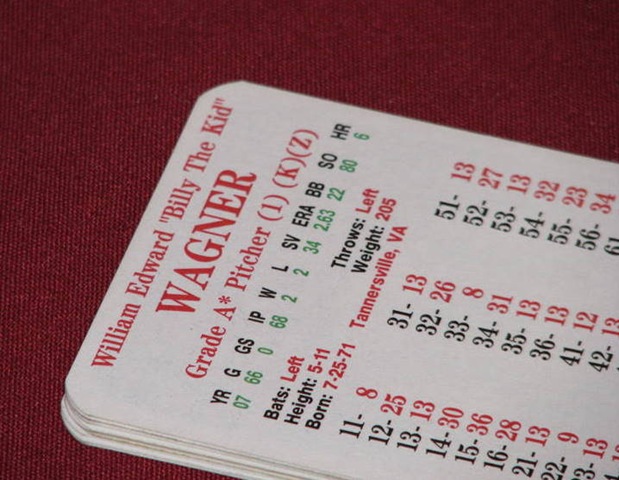 While I won’t waste my virtual breath by saying that the APBA sports gaming system is better (everything is so subjective), I can say that certain sports board game engines are more suited for some and their competitors are suited for others.
And the interesting thing is, the reasons why the APBA model works for me has little to with complex statistics comparisons. Mostly they are practical reasons.
Before I go on, here’s my disclaimer… I’ve played Strat-o-Matic enough games to know how it’s played but not enough to be an expert. If any Strat fan reads this and still totally disagrees with what I say in this article, flame away.
My reasons for staying with APBA:
1. Rhythm/Pace of Play
This is a big reason for me. This assumes you are either playing solo or have two managers who know the boards pretty well. If so, the dice rollin’ gets into sort of a cadence and not only can you get a few games in a short period of time, you and your opponent might be able to trash talk as well.
PS this doesn’t work when one manager knows the boards well and the other is a beginner at APBA. It almost works best if two beginners learn the game together unless you have a very patient teacher (“Strikeout. It’s a strikeout! I promise you every 13 is a strikeout! Don’t bother looking it up!” *fingers tapping*)
2. Cards are easy to “Read”
This seems like a piddly thing but for some reason, it matters to me. In APBA, all the numbers are where they’re “supposed” to be (usually). The best result is at 66, the next best at 11 etc. The result at 45 is almost always a 14, you know where I’m going with this.
The point is that I can look at an APBA baseball card and within 10 seconds, I could give you a good sense of what that card should hit in a full season (assuming average pitching).
On the same note, a good dice roll is a good dice roll and vice-versa in APBA. I can count on getting a similar result with Ryan Zimmerman as well as Eric Hinske with a dice roll of 44.
Like I said, it seems small but we (ok, maybe I) like to root for certain numbers to come up. It just makes it easier if you know what those numbers are on a consistent basis.
3. APBA is more Accurate
Again assuming MLB average pitching, APBA hitters tend to be more accurate (I’m talking accurate not necessarily realistic. see below) to their real life stats. Now when you’re in a 10-team league like I am where pitching is incredibly heavy, you can throw that out the window. But overall, APBA tends to recreate stats better in my opinion.
4. The APBA Game Engine is very modifiable
The game of APBA is immensely customizable. Like the game but don’t care for one or two of its features? Change it!
These days when we are getting away from from the do-it-yourself culture and are told we need to have everything force fed to us, the idea of getting a game AND CHANGING THE RULES is foreign to most people. But this is one of the best reasons I like the game of APBA dice baseball.
Don’t particularly care for the way handles the unusual numbers or error results? Then implement a randomized charts like the Unusual Play Chart or Error Chart. APBA’s pitching system not specific enough for you? Well there’s always the Master Game but you could also implement recognized and tested systems like the Coxx Pitching system, too.
To be fair, I’m sure Strat-o-Matic most likely has modifications to its game as well. I’m just not as familiar with the game.
Am I bashing the Strat-o-Matic game?
Not at all.
As I said, I’ve played the game (at least 20 or so games) enough to get an idea of how it is played. I found it fun and as near I could tell, it was realistic and accurate.
But I came back to APBA for the reasons I explained above but mostly… because it was the game I grew up with.
In the midst of writing this, I spoke to Brando, one of our managers in the IAL. Despite being in our APBA league, Brando enjoys Strat and finds a lot of advantages in the game.
It does incorporate some facets of baseball that APBA does not such as L/R matchups, increased fielding/range ratings, and more specific pitchers ratings. To put it simply, Strat wins the “realism” (as opposed to accuracy) battle (though I am sure there are some arguments to contrary).
I could go on about the other features of Strat but one, I’m not really qualified and two, it’s not really the focus of this blog.
I’d love to hear comments on this article especially from APBA fans who have played Strat-o-Matic. What was your impression of the game and why did you come back to APBA.
66s!

I started playing Strat in 1969, when my brother ordered it. I was introduced to APBA in 1974 when a friend of mine got a copy. I stuck with Strat – I liked that the pitchers had more “realism” to their cards – the “outliers,” in terms of strikeouts, walks, homers allowed, etc., would stand out, whereas APBA just had, essentially, 4 pitching grades, four strikeout ratings (none, X, Y, and XY), and three control ratings (Z, W, and none).
I continued playing Strat but around 1996 I found a copy of APBA in a street sale in Wisconsin. I couldn’ resist. I took it home, and played a few games, and I was hooked.
So why do I prefer APBA? A few reasons – the game engine is tweakable, so I can overcome any reservations I have about the game, 2) there are a few more unusual or rare plays that S-O-M may not have, and 3) S-O-M has their basic, advanced, super-advanced, and so-advanced-if-you-figured-it-out-we’d-have-to-kill-you versions. APBA keeps it simple.
So there you have it.
31’s on the hit and run,
Steve A.
I have played strat since 1967,the number
of games is in the thousands.In 1979 I was introduced to APBA,I thoroughly enjoyed the game, I did have some reservations about the small number of pitching and strikeout ratings
though.The one thing I really liked about APBA
was the Rp boards,or play result boards I liked them so much that I added them to my Strat game.I’m not saying Strat is better than APBA just that I was a fan long before.
Steve,
Yes, so many have said the reason they play APBA is either because it is simple or because of its quick style of play.
Nothing against Strat.. it definitely has its strengths and I see why it has its share of followers.
I was a Strat player in the early 60s (62 and 63 season). I switch to APBA for the 64 season after Maury Wills (0 HR season in 63) hit 3 HRs in one game off of Tracy Stallard’s pitching card.
When I switched I remember missing the ability to call steals. But APBA gave a better all-around gaming experience, and quicker games to boot.
Both the Strat and APBA games have gotten a lot more sophisticated since the mid-60s, but there’s too much nostalgic power in an APBA card for me to consider switching back.
If a player with 0 HR (and therefore W power) hit 3 HRs off a pitcher’s card, you’re playing the game incorrectly. All HR chances on pitchers’ cards are for players with N power. For players with W power, those turn into singles that advance baserunners 2 bases.
That has not always been the case. I haven’t played Strat since 1966 but back then a 0 HR guy could hit a HR off a pitcher’s card. It many have and probably has changed since then, but back in the original days, a hr was a hr was a hr.
You’re correct, Jimbo – but only in the advanced version of the game. In the basic version there are no ‘N’ or ‘W’ denominations for hitting power. Maury Wills could indeed hit 3 hrs in a basic game.
A bit belated, but I’ll chip in – I played S-O-M and used the same teams over a period of years. I had the 1971 Orioles and Mark Belanger was always destined to hit a grand slam once a year, even though he had no home runs in ’71.
When you think of it, that’s an easy house rule to make in S-O-M basic: if a guy had no homers during the season, then any home run becomes a SINGLE**.
If Maury Wilds hit a homer, you where playing the game wrong. Batters are rated, if they hit few hrs they get a W rating, if they are avg hr hitters, or above they get a N rating. A W rating CAN NOT hit a HR off a pitchers card, that what N-HR means. It would become a single**. Strat is a much more realistic game, it also has rare plays, you just have to learn how to play the “Super-Advanced” version. Just my observations, have played APBA 150-150-200 times, strat 40,000-45,000 times. I maybe biased, but strat is by far the most realistic sports Sim tabletop game.
nostalgia/tradition.. that’s actually a big reason for me I never brought up.
APBA is big on that (almost to a fault).
TO: Steve Stein abd Jimbo: Interestingly you are both technically correct. In the Strat-o-matic BASIC game a player with 0 HRs could hit 3 HRs off of the pitcher’s card. The “N” power ratings and “W” power rating are for “advanced” and “super-advanced” play only. However, the likelihood of any player hitting 3 Home Runs is astronomically low, though not impossible, and one wonders if Mr. Stein is a dedicated APBA advocate taking a swipe at what is a minor weakness in the Strat basic game. Baseball is a game where statistical flukes occur all the time so I do not begrudge those sorts of things when they occur in a boardgame format, because almost anything can happen in real baseball. Consider there are pitchers who have won I think less than 10 games in the big leagues, but who have thrown no-hitters, yet the New York Mets franchise was in its 51st year before it had its franchise first no hitter (with guys like Ryan and Seaver and Gooden and Koosman and Cone etc. having pitched for them). That would seem to me about as unlikely, mayber moreso, as Maury Wills, who hit as many as 6 HRs in one season during his career, hitting 3 in one game even if in a game using a card from a specific season in which he hit 0. I reitterate, I love both APBA and Strat–but that APBA nostalgia and those magical cards are a powerful intangible.
I have played Strat for over twenty five years, and currently have a replay going. But recently I purchased APBA and after playing twenty games find myself getting used to the “boards” and really enjoying the game. So I play both, with a different replay going for each game. Its a great hobby we have, and either way, strat or APBA, we seek the same thing, enjoyment.
I was introduced to Strat baseball and football by a friend in the 80s (I’m 37) and appreciated the advanced versions of their football much earlier than baseball. Maybe 2 years later, the same friend’s dad taught us to play APBA, which for some reason seemed to be more of a grown ups game, lol. It didn’t take long for APBA to completely win me over although I continued to play Strat leagues with some friends. I haven’t bought a SOM game since the mid80’s, but I do play the online version through sporting news, so I’m still very familiar with the cards and game itself.
Despite the fact I haven’t played APBA for about 5 years now, I still prefer it. The cards have so much character and the interplay with the boards, team defensive ratings…and the nicknames (lol)… it helps the game capture something that Strat just can’t. If APBA were to swing a deal with say ESPN and compete with online strat, I’d jump in a second as well. The Windows version of APBA with Ernie Harwell– again– better captured the ‘feel’ of baseball to me. I played through college and that means a lot. Interestingly, most of the strat guys I know just don’t get that, lol.
I agree with you on APBA character of the
cards, with nicknames, Height, Weight, born,
and hometown on each card. This gives me a
feel of the game players, even if it’s an old
season that I may have never seen before. I
also like the size of the cards, and the team
envelopes that come with the card sets. I could never get the feel of the odd sized cards with Strat.
If Strat had APBA’s graphics designer, it would be no contest, IMO. APBA looks so much better, and does have the “old-time” feel to it. I don’t lke the lack of CS’s or the lack of incentive to go to the bullpen — but there isn’t one in Strat, either, not in Basic, which is the only one I play.
I like the individual pitching cards in Strat too much to ever say APBA is “a better game.” I love them both, though.
Joe
It’s because of your familiarity with APBA. I’ve played both games for over 40 years and to me Strat looks so much better than APBA in EVERY way! The APBA cards look like some ‘mumbo-jumbo’ spit out by a IBM computer while Strat cards are easily understood by anyone who knows about baseball. Any baseball game that has to use different boards for different base situations is already playing from behind and trying to catch up. All of Strat’s sports sims perform like real life no matter what the situation. With APBA, you have to constantly check base situation, pitcher grades, what position on the field in football, what quarter your playing in, what offensive grade your team has, and on and on. It gets a little rediculous after a while.
I’ve played both: APBA basic during the 60s and 70s, Master in the 80s, Strat in the early 90s, then Baseball for Windows in the 2000s. This year I’m returning to APBA, probably the basic game with a few modifications. What brings me back to APBA are many of the things Zealot notes in his post: ease of play, familiarity with the boards, and flexibility in adapting optional rules (I’m thinking of buying a basic game and master game symbols to create a amalgam of basic game + master stealing and pitching grades.). Strat handles platoons and fielding range much better, but the sacrifices in speed of play don’t work for me. I’m playing a draft league, and I;d rather play a few more games so I get better cumulative stats. (I never thught of that Maury Wills/Tracy Stallard scenario, Steve. Good catch.)
I’m not knocking Strat; that might be my choice if I played with someone else regularly. For solo play, APBA is my choice.,
I’ve been playing SOM since the 1970’s and like it very much! Recently a buddy sent me some APBA stuff,and I like it too tho’ I haven’t played it yet.I like all the games!
I’ve played both and chose Stratomatic, pretty much hands down. There are things to like about both, but those APBA people who claim Stratomatic isn’t customizable haven’t given it a shot in the last…oh…about 10 years or so, especially the computer game.
You can play basic (what I consider pretty similar to APBA), advanced, super-advanced, and super-advanced/max rules…or any flavor in-between and any combination of the new rule tweaks.
As far as accuracy, I’d say Stratomatic is the hands down winner here as well.
The only thing I find a little annoying is that while Stratomatic has the L/R “realism”, it can certainly be abused, especially with players who had very few PAs against that side because you can just choose to use the player vs that kind of pitcher. They seem to normalize extreme splits with veteran players, but rookies are there in all their glory, so if they went 7-10 vs LHPs, their card is basically all hits/on base on that side. Almost “too much” realism at that point, but I certainly prefer the advanced L/R splits to the extreme basic nature of APBA.
I will also say that there are times I wish that “all 13s were Ks” and rolls were predictable, but there’s times when the controlled randomness provides a ton of excitement. On the flip side, when the rolls are so easy the outcome is determined the second they hit the table, I feel like I’m just chuckin’ dice and not enjoying the game and getting the full experience.
I can see where minimalists like or prefer APBA, and very detail-oriented people prefer Stratomatic.
@ Steve Stein….those 3 HRs by Maury would be 3 singles now. The game has changed a lot since you last looked at it.
Having played both games since 1966. I have reasons for playing both. I still enjoy the righty/lefty combinations available thru SOM. However if you play APBA with righty/lefty upgrades on every pitching/batting change you get just about the same strategy and enjoyment. APBA tends to favor the teams with better pitching however, and the games have a much faster pace of play. Most of my games are with friends in a tournament format making this the preferred game for play, hands down. The playability and excitement in a 20-30 minute game is unmatched . If I was playing one game only with plenty of time, I would play SOM.
I am in a basic APBA league with 8 teams. Here’s how we customized our league:
Eight MLB teams were selected and we drafted teams from this pool of players. Everyone had to draft 13 position players, 5 starting pitchers, 1 starting pitcher designated as a “long reliever”, and 4 relief pitchers.
There are no designated hitters. Making the pitcher hit adds to the managerial strategy and makes your bench players more important. Also, since some pitchers’ hitting cards are “inflated” (i.e. – they are a .400 hitter with 2 hits in 5 at-bats), we use a standard “pitcher’s hitting card” for all pitchers. (It happens to be Ryan Dempster’s hitting card).
We ignore all stolen base results (except 11’s) on the APBA charts. We do this b/c sometimes a runner would be out stealing and we would never want him to steal in certain situations. Instead, we made a rule saying you can determine when you want to steal. To steal second base with a fast runner, you have a special roll: the red dice must be 3 or higher to be safe (average runner 4 or higher, slow runner 3 or higher). To steal third base with a fast runner, the red dice must be 4 or higher to be safe (average runner 5 or higher, slow runner 6).
We made another rule that a relief pitcher is upgraded one letter if he enters the game in the middle of an inning to face a batter that is a favorable matchup. For example: A lefty Cz relief pitcher becomes a Bz relief pitcher when he enters the game in the middle of an inning to face a lefty batter. This upgrade “turns off” as soon as he faces a righty batter. This motivates managers to have a balanced lineup of lefties and righties.
Lastly, for starting pitchers we have a limit to the number of starts per season (but no innings limit). For relievers, we have an innings limit per reliever (but no appearance limit).
Games usually last 20 minutes and we keep only the most important stats (AB, R, H, RBI, 1B, 2B, 3B, HR, BB, HP, AVG, OBP, SLG%, OPS%, W-L, ERA).
I personally don’t care if an out is a fly out, pop out, line out, ground out, or strike out, so for stat keeping, we keep it simple.
It’s such a fun league! Any other customized “house rules” that you use?
Chic APBA Player,
What’s the name of your league? Our league (Illowa APBA League) has four managers in Chicago.
We don’t really have a league name. We play the board game version (not the computer game), so we play in person.
Really enjoying reading all the posts fellas! Thanks!
The biggest attraction of APBA for me is the feel of the game. It’s easy for me to visualize hitting that home run when the dice hit the table. Since my memory isn’t that good I usually have to look it up on the SOM card so I miss that feel of getting good wood on the ball, it’s more like missing the live action and catching it on instant replay. I don’t have the stats to back it up, but I would think because there are so many more results possible on a SOM roll, that it would be more accurate. I also like the fact that SOM has seperated the range factor from the error and the result of the play is not determined by the base runner situation. I think that is the biggest weakness in the APBA game. I haven’t bought a SOM game lately so I don’t know if they are still using the generic pitcher’s hitting cards, but that does irritate me. I play both games on a regular basis and enjoy them both.
Hi Brando!
Yup, still 1-8 for pitchers hitting cards.BTW-how long does it take you to play a basic APBA game?
Thanks!
Jim
I had not played either Strat or APBA for about 20 years. I have been playing strictly Diamond Mind Baseball on PC. As much as I enjoyed it, there was something missing… the roll of the dice. So I dug out my APBA cards of the 1958 season (original cards and boards) and started rolling the dice. The game felt so real, so natural and I couldn’t believe I remembered what the numbers still meant so many years later. I played about 40 games in a weekend and just as it was in real life, the K C A’s just couldn’t put it together to win even 20 of their games. I know that the only thing I never liked about APBA was that if your pitching staff was basically Ds, it didn’t matter who pitched. It was just luck of the dice. Regardless I think I will be catching up on some “old season” baseball and playing it with APBA.
I’ve found my APBA board game from my childhood up in the garage. It would’ve been purchased around 1972-74. Can you tell me what card sets were included with the game from those years? I have card sets, but they’re ancient. I’m guessing 1929-1930: Philadelphia Athletics, the Boston Braves, St. Louis Browns, etc. In addition, I have a complete World Series set with 12 teams ranging from 6 series between 1912 (Giants/Red Sox) – 1952 Dodgers/Yankees.
Everything’s in excellent shape, including the boards and rule books. If you’ve got emails of people I can contact for further info about this, I’d appreciate it.
Sincerely,
Jeff Phillips
has anyone realized that there is no way for a fielding 2 pitcher to be injured when the DH is used? only a fielding 1 and fielding 3 pitcher can be injured, but not a fielding 2! (and this occurs on 38 with runner on first and second!) the only way for a fielding 2 pitcher to be injured is with NL rules where the pitcher hits and he must be injured as a base runner. was it this same way on the old boards?
APBA has many more past seasons than Strat and a better range of great teams of the past than Strat. Strat only goes to 1967 except with their new set which includes more teams from the ’60’s to mid ’70’s but NO ’75 REDS of all things! APBA great teams even go into the 2000’s! APBA even has the 1998 Yankees! i believe that Strat has a problem at times with licensing with MLB and therefore there are players names missing from cards from time to time. i know this was the case with Barry Bonds(for example) for several years. Strat is fun, but it definitely needs to upgrade it’s great teams(it included the ’76 Royals for its latest team, but not even the ’76 Reds or ’76 Yankees, and one would think that they would at least venture further into the future unless they have problems with licensing or production!) …….and the APBA personnel are truly courteous and friendly when answering phone inquiries than the rude “don’t bother me, we’re only interested in profit here” Strat personnel.
75 reds have been out there since 76 in strat. Strat has every season since 61. Plus 20 or so other historical seasons.
As a citizen of Lancaster County, PA, I’m almost embarrased to admit that I am an avid fan of Strat’s computer games. I’ve spent the last year trying out the basic board game version of their baseball, football, hockey, and basketball games and I’m glad to say that I’m coming home to APBA.
I like Strat’s computer games because of the insane amount of detail that they provide on statistics and I naturally assumed this carried over to the basic board game versions. The unfortunate part is that this detail is provided at the cost of both accuracy and ease of play.
Anyone who’s played Strat baseball knows that there are a total of 216 different combinations for an at-bat versus APBA’s 36. Plus Strat provides more detail on pitcher performance instead of just four letter grades with one or more of four pitching symbols. The problem is that it takes at least 50% longer to dictate a result, not to mention there is no inherent “rush” in knowing that a 66 means the ball is out of the park or a 12 means you’re batters need to get back in the field. Finally, Strat weighs pitcher and hitter performance equally at 50%, which sounds great, until Roy Halladay and Roy Oswalt hit homeruns in back to back games.
The truth is, APBA’s simplicity is a benefit, not a determent. Plus APBA really is way more customizeable for fans who want to add that extra detail when they choose. I guess it’s best to leave the 20-sided die to the D&D fans…
If your in a hurry to finish your game then play APBA. Back to back homeruns by pitchers? How about back to back errors by a great fielding short stop in APBA because of that darn index for team fielding?! A great fielder in APBA is as bad, (or good) as the fielders around him. So, in APBA, if Brooks Robinson was playing third base for the 1962 Mets he wouldn’t be the ‘human vacuum cleaner’, but just another Dick Allen at third.
I’ve never played either Strat or APBA.
I want to buy one or the other but I’m not sure which which one I’d like better.
Maybe you-all can offer an opinion, based on the following “personal profile.”
I would be playing solitaire. No leagues. No one playing bu6t myself. (I plan to apply for a job as a full-time hermit. lol)
I also would be playing the computer version of whichever one I decide to buy.
I used to LOVE playing Earl Weaver Baseball, which I can’t play now becvause my six gig computer plays it way too fast. I realize EWB is a different breed of cattle than Strat or APBA, but what i especially liked about EWB was the *graphics* — flight of the ball, movement of the runners, fielding plays, the ball in the air and not knowing if it would clear the fence. … And from what I gether APBA has better graphics than Strat. True?
I was put off a bit when I read that there’s no lefty/right splits in APBA. Or the ability to decide when to steal — Am I correct in that?
I love the lefty-righty option, but at the same time because I prefer playing teams that existed in the 50s and 60s, I realize that MLB didn’t compile lefty-righty stats until I beleive it was sometime in the 1970s or 1980s (???) Again, correct me if I’m wrong.
Also, someone said the APBA support staff is much better than the Strat staff. I called Strat to ask a few questions and the guy who answered the phone sounded like he was 13 years old — not that I have anything against 13 year olds — but he was no help whatever. I also noticed that their telephone tech support was $1.99 PER MINUTE. (That’s more than Angelina Jolie’s been charging me!). ..
I’m somewhat “computer literate” but not overly so. That being the case, would I likely have to make a tech call or two or submit an e-mail question to tech support to get up and running?
Also, I like compiled stats. As such, is there any noticeable difference in the computer versions of the two games in terms of how they compile and display statistics?
Finally, is there any great difference in terms of the learning curve required for basic play and more advanced levels of play?
Anyone “gamer enough” to answer all of even some of these questions?
Thanks,
Tony Manna
APBA’s Master Game is my preference. It’s more complicated than the basic game and takes longer to play, but addresses the batter/pitcher L/R issues, provides 30 pitching grades, 20 grades for a player’s running speed, arm strength ratings, stealing ratings (you decide when to attempt to steal), fatigue factors for pitchers and more. In my opinion, it is the ultimate Baseball Board Game. 66 is still the number to roll. 13 is still a bummer to roll. I hope the move from Pennsylvania to Georgia will not impact on the quality of the game.
Keep the dice rolling.
Randy Long
Just a clarification to my previous comment. 13 isn’t a bummer to roll, it usually provides a walk. 12 is a BUMMER to roll. Just adding this in case an APBA fan stumbles upon my comments.
Keep the dice rolling.
Randy
Not sure where to post this. We are an 18-team retro league currently finishing the 1991 season. We are in our 37th season. The name of the league is SABA (Southern APBA Baseball Association). We currently have openings for a few teams as a couple guys had to drop out due to health reasons. The new season will start in Ocdtober and the draft is this weekend. Drop me a line if interested. Our President Bob Grant lives in Nebraska and I’ll pass it to him. The rest of us are scattered across the country with a few of us in the Atlanta area. Thanks.
Wayne, you should definitely post in APBA’s Between the Lines “Leagues and Replays” section.
http://forums.delphiforums.com/apbabtl
Good Luck!
I love all three games,the sks stuff as well!Planning on a 1962 LAA Replay soon with the sks cards.It’s all good!
Happy gaming!
BK
I’ve played APBA since 1973 (baseball/football) and played the card games into the late 80’s. I switched to Strat’s computer baseball around 2003 and enjoy its playability and accuracy.
I also found, back in 1994 or 1995, a company that nobody has mentioned called Dave Koch Sports. I am absolutely hooked on their football games and they are extremely relaistic and playable. I still prefer the Strat computer game over the Koch baesball games, though.
But for pure nostalgia and fun, nothing beats the APBA card game.
I’ve played Strat baseball since 1984, but I haven’t ordered a complete season in years. I remember trying APBA when I was a teen, but the generic pitcher ratings, team defensive ratings, and situation-dependent play results all seemed to take away from the batter-pitcher, ball-fielder heart of baseball that I found in Strat. APBA to me always felt like a predetermined exercise in dice-rolling, made worse by the inability to call a steal, finding that a runner that you would never have given the “green light” to has just been thrown out in a crucial situation, or a player has been ejected for arguing a call. I also found that APBA lacked a certain rhythm; old-fashioned rallies with hits/walks strung together were few, replaced by lots of 66s. I understand the appeal that APBA holds for those who love it (the feel and look of the cards, the pleasing familiarity of the numbers/results, the thrill of rolling 66, etc.), but for me the game is so passively deterministic that it almost doesn’t need the player.
I am a biased opinion because I have never played Stratomatic, but I honestly have no desire because I enjoy APBA so much. The game is smooth and can be played in less than a half hour and it is simple, yet accurate. More than anything I love that APBA was passed on to me by my Father. Even though he hasn’t played in some time, he still enjoys hearing my stories whether it is about the Bridesburg summer league or a replay that I’m doing. He is always quick to share a story about a replay or season that he played when he was younger. There is also something about the cards, I don’t know what it is,but it’s like putting on a glove and smelling the worn leather and remembering the plays you had with it……if that makes any sense!!!!
Well said Mr.Cavanaugh. There really is something nostalgic and sweet about those cards.
I find that the APBA to Strat comparison is almost like comparing Pro to College football or pizza to charbroiled burgers…they are one and all among the great things in life and it is best to experience each and all as your whim dictates. I maintain that one of the most memorable moments in my life was opening on Christmas morning 1969 a big square package and there before my eyes was APBA football, with that color image of the Colts and Vikings on the box and those big boards and team envelopes inside. It remains the greatest Christmas present I ever received, inextricably linked in my mind to the Vikings-Rams playoff game that year played two days later of which I was sadly (at that time) forced to miss because I was compelled to go horseback riding with my father who– infinitely and forever more sadly–was lost to us by the next Christmas from a heart attack. I doubt if he realized that the gift he probably thought of as a toy of some kind ordered from a magazine ad would give me pleasure for the rest of my own life.
I agree with Brian, APBA was passed onto me in the early 80s by my dad as well. I finally broke down after reading abt Strat & bought a game, all there old timer teams, 36 teams of the past &1977 season. I read & figured the basic game was for me. I played some games & I found it very laborious. I liked the idea of the focus on batter/pitcher but as I played the game I just couldn’t get comfortable. I began reading abt APBA again & I have liked the updating. I realized it was the ease & familiarity tht I missed. I never thought of modifying until I read abt it on Strat sites & the APBA sues. I modified my basic game & have returned & will keep on rolling!! It is the cards, rolling & hearing the dice hit the table! I found it difficult to know what cards are strong & weak. I want more volumes of Great Teams of the Past:) APBA keeps it simple & allows room to modify without taking from the game. You can have details without getting bogged down in them. I like tht the result boards tell you what happened & let you
know who made the plays. Don’t get me wrong, there are lots of things I like abt Strat bt in the end it was the old broken in glove tht you love!
Shawn Kaufman
Lets Go Cubbies!!!!!!!!
Shawn Kaufman
I have no use for a game that doesn’t treat pitchers individually. I prefer pitching to hitting which most people don’t so I get that. My favorite thing in all sports is a 1-0 game. You’re telling me that Koufax and Clemens are the same and should use the same card? also , batting order doesn’t matter in APBA because the results are all the same
EXACTLY!!!
It’s kinda funny…the exact reasons you prefer APBA is why I prefer Strat. There’s too much of a ‘sameness’ in APBA that gets boring after a while. What you mentioned about your game with Giusti and his pitching grade change is a perfect example of why I prefer Strat over APBA. When you have two or three pitchers on your staff who are say…B (Y), you have no reason to pitch one over the other. In Strat each pitcher is really an individual, (just like in real life MLB)and he has a say in the outcome of the game he pitches. In APBA the pitcher is more like a batting machine for the hitter. Roll a 66 and most likely it’s a homerun. If you keep rolling double numbers on the APBA dice you’ve got a pretty good chance to win. And don’t even get me going about outfielders and the 1, 2 and 3 ratings! LOL!
I’ve been playing Strat since 1967 and APBA since 1969 and I like both games. Strat flows just as easily as APBA especially when your playing the advanced or super-advanced game to APBA’s master game. You roll the dice and get your result quickly off the Strat card. With APBA you have to constantly check the board and base situation and the pitchers grade and if it has changed because of the hitter. Strat is right there in your face baseball!!! You roll a homerun and it’s a homerun. You don’t have to check two or three other things just to be certain. And when your pitcher, (like Koufax) is getting Ks off his card it’s right there and cool! With APBA you have to be careful not to miss those guys with a x, y, z, r, K,…SHEESH!!! You get the picture!
Hi Brad,
I’m glad you enjoy Strat-o-Matic. As I said, I really do think it is a pretty decent game. I just prefer APBA and thought I’d outline why in my article.
The issue of which tabletop game we each enjoy is not one worth arguing about. Life’s too short. Let’s play our respective games and have fun instead. :)
Tom
Tom,
You are correct!! Life IS too short. That’s why I’ve done away with the other games that were wasting my precious time and stuck with the game that’s the most realistic…STRAT-O-MATIC!! ROLLIN’, ROLLIN’, ROLLIN’….
I’ve played both games — started out with APBA in my early teens, then switched to Strat-O in college — and I agree with Brad. He explains Strat-o’s superiority pretty well. I think APBA is a fine game, but the lack of platoon splits and the sameness of the pitchers really gives Strat-o a huge edge. I play the advanced game, and even if it makes games a few minutes longer to play, it’s a more rewarding and realistic experience.
You got it Mark!!! I admit I do play ALL baseball sims, and they are indeed fun. But, when I want a serious replay of say…A World Series from years ago, (or recent) I choose Strat because it just feels more like real MLB and the players really ‘perform’ on my table top like they do in the Big Leagues. I wish APBA would at least add to the OF defensive ratings. 1-3 is not good. And the fielding index thing is really bad.
I started with Strat but a year later switched to APBA and have stuck with it ever since
Why?
Strat strove for identical stats to real life, but in doing so altered the game. A good power hitter is just that..no a 38 vs 42 hr hitter
APBA is more aware of the nuances of the game situation..for example..pitchers hate to walk a batter with a man on first..hence a Z for those who can..Strat doesn’t care. This is repeated over and over on the play boards
Rare plays enrich the texture of the game
Strat DOES care. That’s why the proof is in the pudding…The final stats. I’m glad Strat never tried to add all the x.y, z, W, etc. of APBA and the ^, *, W, w and all the other crap REplay needs to make the stats come out right. SOM does it without all that and is so much more like real MLB it ain’t funny!! The other games are Strat wannabees. People complain about the 50/50 system, but it’s the only one that delivers right on the money year after year, after year…for over 50 years!! You’ll never find a 6 column chart OR base situation chart that will ever be better than what the SOM 50/50 ‘in your face’ baseball game offers. Strat doesn’t need smoke and mirrors because it’s the only game that’s REAL baseball on the tabletop or computer.
I agree. The final stats are insane. The realism is amazing.
Hey, all of you who are still playing APBA and/or Strat-o-Matic.
You need an education. There is a new breed of statistics-based baseball sim games that are 100% computerized, and the best of them are, in my opinion, Action! PC Baseball and Diamond Mind Baseball. Both of them are far better than both APBA’s Master Game and computer game and Strat-o-Matic’s best version on computer.
I have along history of playing APBA and Strat in their various versions, and they simply do not compare with the best computer games. I know, because I have played replays with all of them and have found the best computer games to be both far more realistic and more statistically accurate.
Would you like to play a game that allows you to account for the weather, whether the game is played at night or in the day, ballpark effects of ALL ballparks in the major leagues since 1900, etc., and which allows you to play in pitch-by-pitch mode, to pitch around a hitter without walking him, etc., the way that baseball is really played? If so, then try both Action! PC Baseball and Diamond Mine Baseball (which are competitors of each other, just like APBA and Strat), and by the way, nobody is paying me to write these comments.
BIG YAWN….Been there…Done that…ZZZZZZZZZZZZZZZZZZZZZZZZZZZZZZZZZZZZZ
So…having ALL ballparks since 1900 and pitch to pitch mode makes those games good? That’s like saying, “Oh, these cards are pretty looking, I think I like this game!” I’ve played DMB and Action, along with Replay. They are all dust collector’s. They are fun kids games, but not a good representation of MLB OR it’s players. I will give them an E for effort though!
I’m 14 and discovered strat o matic this winter. Better than any MLB The Show i’ve played. It changed my life. I have a draft league i do and i managed to get my friend into it so I respect all games. Thank you strat and best of luck to apba!
I’ve played APBA from 1957-1962, came back to it in 1973 to present. Love playing the old seasons. Have played in a 8 team FTF league since 1980, we play with drafted teams and draft rookies each yr. We have made changes to our basic game rules to be
close to the master game, but not as time consuming, as most of our games are 30-40
min. in playing time. We play weekly, 6 games a night once a week. I own the Strat game and have played it a few time, but never had the feel of the game. With APBA I feel like I’m almost at the game.
With pitching I agree APBA has some limits,
But I could never feel a 50/50 split with pitching and hitting was that real either.
Apba stats may not be perfect, but that’s what makes it fun for me. You never know how well a player will do for a season. Would you want to replay a season and have the stats and standing to be the same as the real season? Not me, I like to see something different. APBa Baseball is the game for me. I’ve played APBA Football, but
with all the board game changes I’m not sure
with boards I would play with if I picked up again.
Yeah, 50/50 system is too much like REAL MLB. You know…batter vs. pitcher instead of batter vs. uh, batting machine? A pitcher GRADE?!
In 1977 at age 11 I located a Kay Bee toy store on the route of our summer vacation in Green Bay, WI and had my parents stop and buy me strat. It came with 2-4 teams I think. I remember expos, pirates, brewers. Played it all vacation and loved it. What I’ve never been able to figure out is what caused me to ask my parents to buy me APBA the next year. I think it was that amazing color brochure and the great insert detailing everyone’s replay results. I was immediately hooked and never went back to strat. I think it was probably the ease of play at that age, the simplicity and beauty of the cards, and not having to turn over a separate random play card to get the result. 66-1 was a home run. The 1-16 HR, 17-20 double thing kind of made for an uneven experience. Both games are great of course but the comfort of APBA will keep me a fan forever. (And when my 7 year-old son played his first game last year he rolled a 66 on his very first roll so he’s likely a fan for life now)!
Thanks for that post!!! You just told us everything we need to know as far as who should play SOM and who should play APBA!! LOL!!!
I played both SOM and APBA in the 60s. I even ran a play-by-mail APBA league one year. APBA does play quicker, and the game components are way cooler! However, I still grimace when I think of the following about APBA:
1. I remember Willie Mays one year had a 1 and two 5s. So with bases empty he had 1/36 chance to hit a homerun and 1/18 to hit a double. But with a runner on first, he had a 1/12 chance to homer and zero chance to double.
2. If a hitter only hit doubles, he would get a single column with one (or more) 6. However, if he comes up with the bases loaded, he now can hit a triple and no chance to double; with a runner on third that 6 becomes a homerun (if I remember correctly).
3. In hundreds of games, I NEVER had a Z pitcher walk a hitter with first base occupied.
4. If you had one 3 outfielder, you would always put him in right field since it eliminated an error chance with the bases empty. Yaz in right field……yeah right!
5. Good fielders didn’t take away hits (or if they did, it was extremely rare).
Don’t get me wrong; I enjoyed APBA baseball. However, Strat-O-Matic is a far more realistic game that has improved dramatically since the 60s.
I wouldn’t expect an avid APBA player switch games unless things like I mention above are bothersome or unless they are looking for more statistical realism.
I could not have said it better myself Bill! APBA is a fine game…for a 6 year-old, but when he grows to be a man, he plays Strat!!
Hey Brad!
First,I hope everyone is doing well in Bradsyvinia!
Gotta tell you, Bud,this post has me laughing..Honest to God, Pal,it’s one of your funniest ever!
I can just see some bird,walking in SOM..with his BC for proof –
“OKAY UNCLE HAL…SERVE UP THE STRAT..TODAY I TURNED 21…I HAVE THE PAPER TO PROVE …ADIOS APBA-.. SERVE UP THE STRAT! !!!…BECAUSE TO-DAY…I AM A MAAAAAANNNNN!!!!.. (PICTURE JOHNNY WEISMULLER WITH THE TARZAN CALL!)
Travel safe, be well!
GOD BLESS ALL!
PEACE&LOVE,
IN FRIENDSHIP,
Jim
Bud,drop a line anytime me email is-
Hi Bill!
Great post, Sir! …I’ve played SOM..Since 1976…Let me say tho’…It’s dropped to #3..Behind #1 APBA. ..#2 SKS..
Let me tell you why..BABE RUTH. Has never hit .300 in his life here. . In one league I rolled. The results after a 154 game season. .154 games for 16 teams..just for the record. .
BILL MAZEROSKI .301
WILLIE MAYS .297
BABE RUTH .287
Folks’ll say “sample size..sample size..sample size. “..That’s okay, but when your sample size has BABE RUTH continually being a nose diver..it bothers me. . Still play it..But, thank heaven there’s APBA/SKS.. Babe’s a MONSTER! !
Have a good one!
Jim
APBA is still my number TWO and the game you mentioned in your post, SKS, ain’t even in the top 20!! LOL!!!
REAL MLB IS 50/50. A tense duel between pitcher vs. batter! APBA is the alphabet and 4 guys on the staff with exactly the same ratings!! Strat has been around since 1961 and I think it’s safe to say that NO batter OR pitcher has ever had the same exact card. Not for a season and not ever!! APBA is fun and kinda cool, and you don’t really have to care that much about stats. Roll ’66’ and almost any batter hits a homer!! Strat is fun, really cool, and so realistic you feel as though you are actually watching Mays, Mantle, Williams and Koufax right on your tabletop!!! And the final stats have always been just about spot on for over 50 years!
One thing I like about Strat is the ability to pit Koufax against Ruth, or Spahn against Cobb!! Any of these players cards are completely different according to the season you choose. With APBA, Koufax with an ‘A-X-Z’ from say, 1963 is the same as any other pitcher with the same ratings! Roll a ’66’ with Ruth, HR! Roll a ’66’ with Mantle, HR! Too much of the same for me. I like variety, (the spic of life!) and Strat has it in spades!!!!
Brad – Why do you keep coming to the APBA Blog to yell at APBA players? How old are you? Learn some social skills man, you keep ranting about the same thing. We get it, you love Strat.
Why do you keep asking? We get it. YOU love APBA. How old are you? If all this really upsets you, you need to get a life my man.
Babe or any other hitter is a ‘monster’ when you roll 11’s or 66’s in APBA!!! For that matter just keep rolling doubles and your a freakin’ monster!! Why? Because in APBA the hitter doesn’t face a pitcher, but a GRADE!! HA! HA!!
And when Don Kessinger rolls a 6-9 against Luis Tiant in SOM basic it’s a homerun. It didn’t matter who was batting.
It does if your playing SOM advanced or super-advanced. BTW, why couldn’t Kessinger hit a home run off Luis Tiant? Especially if your playing in right porch friendly Yankee Stadium! Less formidable hitters hit them off Luis in real life!!
I said in basic. Of course Kessinger could hit a homerun and as a matter of fact he could hit 10 even though he didn’t hit any.
I think they are each great games and I play them both. Negamco is fun too, and even Cadaco All-Star Baseball….Of course there are strengths and weaknesses of each concerning technical and statistical nuances, but any of the aforementioned games bring to life the great players and teams and the joy of managing them has regaled me for many years and will
always be a great way to spend my free time.
The dice and the cards are great for both
APBA and Strat, however if you move into the world of computing, the best game out there is PC Action by DK Sports. I still can get a kick out of playing with my APBA or my Strat cards, however when I decide to play a full season and hope to get realistic player results. I get out the PC and play DK Sports (30 day money back guarantee too!).
I tried PC Action baseball because it was a free download…HATED IT. Didn’t really hate it, but it was pretty bad. Even the old APBA BBW game from 1995 featuring Ernie Harwell is still light years ahead of Acttion! PC baseball.
Brad is a bit of an annoying dipsh**.
Chill out, old man. You aren’t going to convince anyone to switch.
Jason is a lot of an annoying dip shit! You learned someething today old timer…8 APBA and Action! PC gamers have jumped ship for SOM!! It’s okay Jason. There are a bunch of you who prefer an easier, less challenging board game.
You guys realize we’re talking about a GAME right? Let’s try to be civil about this. It’s not the most important thing in the world.
I agree. As a bit of a newbie to tabletop baseball I will tell you this. I bought SOM a month ago and I’m replaying the 1955 season. I love it. I just ordered APBA (haven’t got it yet) but I will be replaying the 88 Red Sox team and watching wade Boggs, my favorite all time player. However I will say this..as statistically accurate as these games are..THEY ARENT REAL!! Fun and incredibly lifelike but not real. I heard a couple adults at the mall the other day discussing a fight between Spider-Man and the hulk. The conversation was extremely similar. Both are great super heroes but some prefer to read spider over the green guy!!
We know that Kevin. It’s all in the spirit of the political campaign season and Donald Trump. Like Trump, we are all just blowing out hot air and having a little fun with our ‘political foes’. No hard feelings. I certainly hope no one takes all this too seriously. ALL games are good and we are very fortunate to have such choices.
What I think we must remember when finding shortcomings and criticizing the game(s) that are not our favorite(s), is that a non-gamer could belittle any game as unrealistic….No board game can simulate a nagging injury, or a humid windy day, or a player in a red hot zone, or one temporarily down due to personal reasons at home, or a hitters ability and tendency to bomb good pitchers but who struggles against bad ones and so on….So it is incumbent we recognize that all games require imagination and accept that there is a lesp of faith that your chosen game is faithfully bringing to life players and teams from the past and present and thrill at that very concept and have fun….I love them all! APBA, Strat-o-Matic, Negamco, Status Pro, Sports Illustrated, Cadaco All-Star (Ethan Allen), and more. What a great game is baseball and our ability to keep the Boys of Summer alive forever!!! Life is good!!
Well said Kline. There’s no reason for people to bash another person’s game. It really just comes down to preferences anyway.
Comparing BASIC games only, I think fielding and pitching is handled better in SOM. SOM may give you closer pitcher hits allowed and HRs allowed stats but APBA may give you closer pitcher/team won/loss records and player HR totals.
APBA includes many baseball plays/events that SOM leaves out (HBPs, pick-offs, balks, rain outs, player ejections, etc.). The lack of unusual/rare plays in SOM might eventually make it feel a little routine/mundane during a season-long replay. On the other hand, APBA’s situationally based play result boards will create some quirky results at times though sometimes a little quirkiness can be good (fun). For those who don’t like quirkiness, there are add-on charts available that better randomize rare plays, errors and extra-base hits.
When it comes to stolen bases, the two games differ greatly in how they handle them. With SOM you must make a diligent effort to give every player the appropriate amount of SB attempts. If you don’t stolen base totals can be way off. This is difficult to do because it’s very tempting to send A or AA rated stealers too often and rarely or NEVER send those rated C or lower. In APBA, SBs are already built into the game so SB totals should come out close to real-life. Unfortunately, in APBA the CS will come out too low.
Overall, I think SOM Basic is better than APBA Basic for head-to-head play because it offers a little more coaching decisions. APBA might be better for those who play solo or like being more of a spectator than manager.
Pursue The Pennant was on of my all time favorites. Itadded wind conditions, height of the wall, ability of a pitcher to hold the runner on. And also fatigue on a reliever for the number of times he warms up.