IAL finishes 2009 season and Congrats to Teddy B!

A quick note:  The Illowa APBA League’s web site has been updated.  It’s the final edition of the 2009 season which if my math is right, was our 35th season. 

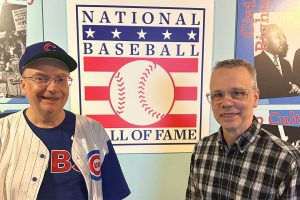
Mighty congratulations to my blogging cohort, Teddy Ballgame whose Chicago Champions won 99 games.  That not only  clinched first place but was eleven games over the second place team. 

Our playoff/draft weekend is set for March 12-14.  The month of February is the closest we get to an off-season only that it’s full of trade talk and speculation of draft order. 

Congrats again, Teddy!

Related posts

Offense isn’t everything

My 2009 season in the Illowa APBA League is proof that a good, or at least decent, offense isn’t everything.  My Twin Cities Thunderchickens just finished the year in last place out of ten teams. 


  2009 ILLOWA LEAGUE W L PCT GB
1 Chicago Champions 99 63 .611 0
2 Rising Bamm Beano’s 88 74 .543 11
3 Molly Putts Marauders 87 75 .537 12
4 Three Rivers Gamblers 86 76 .531 13
5 Chicago Highlanders 83 79 .512 16
6 Northside Hitmen 82 80 .506 17
7 Green Rock Bombers 77 85 .475 22
8 Moline Upperdeckers 71 91 .438 28
9 Kentucky Kernels 70 92 .432 29
10 Twin Cities Thunderchickens 67 95 .414 32


The interesting part?  The Thunderchickens led all ten teams in runs scored. 


Team Runs
T-Chicks 833
Upperdeckers 826
Hitmen 823
Gamblers 822
Champions 816
Bamm Beano 812
Bombers 755
Highlanders 739
Marauders 719
Kernels 677


When the Thunderchickens did win, we had a proclivity to manage some high scoring games which certainly helped.  The league high ERA of 5.17 probably contributed to this anomaly, as well.

Another slight oddity… our last place team has a good chance of having someone win the league MVP award.  Albert Pujols ended the season leading the IAL in batting average, RBIs, slugging percentage, on-base percentage not to mention coming in second in runs. 

He has some stiff competition (Ryan Howard hit 50 dingers this seaosn in the IAL) but we’re hoping.

Related posts

10 tips for trading in an APBA league

With the Illowa APBA League’s rookie draft and opening day less than a month away, we’re smack dab in the middle of our trading season.  This is evident by the list of trades that our league has made.  I’ve stayed out of the trading fray so far but once we get together in person, it will probably be inevitable. 

Some managers make more trades more than others.  I’ve heard some say they prefer to draft their talent; others say they don’t trust themselves and prefer to trade.  So for those in APBA leagues, here are 10 tips to help in the process of trading with other managers.


1.  Know your strengths and weaknesses. 

Before the off-season, before you even think of making trade offers or consider anyone else’s offer, take stock of your APBA league team.  Get a good sense of your team’s strengths and be honest about your weaknesses.  If you’re serious, a depth chart would be nice. 

If your league imposes player limits, then definitely fill out a spreadsheet with your team’s limits so you know what you need to cover positions.  This is a must.  You don’t want to be scrambling post-draft trying to fill positions via trades.  When you are in a position of weakness, other managers know it.


2.  Understand your goal

Some teams are rebuilding.  Others are ā€œgoing for itā€, thinking they have what it takes to make the playoffs, championship, whatever their particular league structure allows. 

With each goal comes a totally different strategy of approaching your team drafting and trading.  That bum B starter isn’t going to be much worth to you if you’re rebuilding and next year, he’ll be a DW.  Consider trading him for high pick.  What about that position player that had a career year?  Same thing. 

And if you’re a top rung team, consider trading a player with loads of potential but little short term value to a rebuilding team for a low risk short term player (see above). 


3.  Know your opponents strengths and weaknesses

Just as important as knowing your own team is knowing the other teams in your league.  In the game of trading, it doesn’t help knowing your own team if you don’t know who you are trading for. 

At the very least, know the other teams’ weak points, strong points, areas of depth and areas of need.  If one team needs a shortstop and you have three, there might be a good match for a trade. 


4.  Make offers that help both teams

It might be tempting to contact a team manager and a say ā€œWhat do you want for Nick Markakis?ā€.  If I got that, I might give it a thought or two but no more.  Be more specific.  Like I said in #3, learn your opponent’s team and find out what he needs.  When you come to him with a more concrete deal like ā€œI have Nick Markakis.  Would you give me your #1 pick for him?ā€.  He’ll at least be more willing to come back to the table and talk.


5.  Leave room for negotiation

Despite what I said in #4, don’t give away the farm.  No one says you have to make an offer that your trading partner will accept right off the bat.  If I made a deal that a manager snapped up without thinking about it, it would certainly make me wonder if I offered too much. 

Leave some room for a little room for give and take.  Don’t be afraid to be flexible either.  If he wants that B* instead of that C* out of your pen don’t dismiss it out of hand.


6.  Don’t burn your bridges

Everyone has ideas of that one big trade that puts one over on the other guy.  But don’t go into trade discussions with that mindset.  If you get the reputation of a swindler, other managers aren’t going to want to trade with you in the future.  Be a fair trader and they’ll come back and more importantly, they’ll have a equally fair attitude toward you.


7.  Discretion is prudent

When you get into a protracted trade discussion over a blockbuster deal, keep the deal under wraps especially if the other manager requests that you do so.  Nobody likes a tell-all who replies-to-all over email.  Some managers have needs or wants that they would prefer to keep quiet. 

This is especially true when other managers confide their draft pick preferences.  For example, I wouldn’t want my buddy Brando to tell the other managers in the IAL that I’m interested in picking David Price with my first pick of the draft (oops!).


8.  Get advice

Ok I know, this goes counter to # 7.  If you’re in the middle of trade negotiations and ready to pull the trigger but just not quite sure, get a second opinion.  If there’s another manager who’s not affected by the deal and whose opinion you trust, run it by them.  Even if their opinion runs counter to your gut instinct, it’s good to get their feedback.


9.  Electronic is good, Talking is better.

In the old days, we in the IAL used to run up phone bills talking trade.  Thank goodness for email.  It makes thing a whole lot easier not to mention cheaper.  I think I even made a deal via texting last year.  That said, if it’s a complicated trade, the novel concept of TALKING doesn’t hurt either.  It removes some of the miscommunications that can occur with email. 


10.  Announce your completed trade. 

When you and your trading partner finally pull the trigger on your deal, announce it to your league.  Your commissioner will need to know, of course.  The other managers will too, if they are interested in any of the player involved in the deal.

Why not have some fun with the announcement?  Sometimes, IAL managers will format their email announcement like a press release MLB-style. 

***

These tips aren’t rocket science.  But they’re worth keeping in mind.  Sometimes I think I need to pay attention to some of them. 

If any of you have trading tips, experiences, even trading rules in your league, I’d love to hear about them.  Leave a comment and let us know.

Related posts

Cold weather headlines

This that and the other:

With the closing of the Geocities web hosting service, YABL has had to relocate their fine website.  You can now find them at http://webspace.webring.com/people/fb/burgda/.  Important not only to find out about their league but for another reason.  League member and webmaster Doug Burg maintains the APBA Baseball Card 12 List and Publication Data web page.  So many times APBA fans ask me if there is a way to identify their APBA cards… to find out what year they are.  I always point them to Doug’s APBA Card 12 List page.  Very handy.

***

glavine09

Not many times can you say that one player remains with the same APBA league team for 19 seasons.  Such is the case with Tom Glavine who has played for my Twin Cities Thunderchickens since 1991.  Glavine pitched his last game for the  Illowa APBA League last Saturday. 

He retires with an Illowa win-loss record of 241-195.  I posted a tearful farewell to Glavine over at the Illowa APBA League’s web site.

***

Marc Rinaldi wants us to pass the word about APBA Games’ Facebook page.  Be a fan or something.

***

It might be asking the world but Kindle Nation Daily would like to see some Kindle apps based on APBA, Strat-o-matic etc.  I’m not holding my breath.

Related posts

The last series of the year means watching the limits

limits This Saturday will be the last series of the year for my Twin Cities Thunderchickens.  No, I won’t be duking it out for a playoff spot.  We’ve got last place pretty much sewed up, thank you.  But that doesn’t mean there won’t be a little tension when I play the Green Rock Bombers this weekend. 

The Illowa APBA League, like many leagues, have a player limit system implemented.  In short, we need keep from over-using our players.  And I’ll be doing my best from doing that because there ARE consequences. 

Those consequences are a possible drop in next season’s draft order.  So you can see the incentive in dotting your ā€˜i’s and crossing your ā€˜t’s when it comes to players limits

Here’s the short version of our league’s player limits rules:  non-pitchers must not play more than their actual games and at-bats.  Pitchers must not pitch more than their actual games started, games relieved, and innings.  There are some further rules about secondary positions probably not worth mentioning but if you’re interested, check out the IAL Constitution.  One thing that IS worth mentioning… D pitchers have their games and innings limits doubled and straight D pitchers (not D*) can always start. 

So don’t think I’ve been playing my team all season without giving thought to my limits only to be faced with a multitude of limits issues this Saturday.  Our league members all (I hope) keep an eye on them all year.  It helps to calculate the AB/G of the games left in the season That way, I won’t get fooled if Albert Pujols has tons of games left but is low on at-bats.  The same goes for IP/G.

That said, the last series of the season is a bit of nail biter.  Unless we have been really good about resting our starters all season or REAL confident about our limits, it’s touch and go all series.  Not only are we trying to win games but we are trying to keep within our sacred limits.  Normally, we ā€œdo our limitsā€ each month.  In our last series, many of us are calculating our limits left after each game especially for the guys on the fence.  And don’t get me started on the last game (ā€œhold on I think this is Parra’s last out.  Let me check, ok?ā€)

So going into the Thunderchickens’ last series, we look pretty good… as far as our hitters our concerned.  Our pitching situation is tricky though.  I’ll get by ok but I’ll have to keep a close eye on it.

I won’t help our place in the standings but gosh darn it, I’m not losing that first pick in the draft.

Related posts

Satirical piece on dice baseball

This satirical piece on The Sportsman’s Daily about a boy finding a dice baseball game in his dad’s attic is a somewhat funny in a bittersweet way for us APBA fans. 


ā€œIt was kind of cute for a while,ā€ said Jose. ā€œIt brought back some terrific memories like trading Jimmy ā€œToy Cannonā€ Wynn over to Buddy Muldoon’s team for Lee May, Joe Rudi and a pitcher to be named later. It was nice seeing the old double fours being rolled for a homer again, but now Pedro’s got his friends here all damn day long. I hear the comments. ā€˜Pedro, your father was around when Vic Davalillo was playing? Wow, he’s old.’  The little f—-rs. I’ll show them who’s old.ā€


Funny or no? 

Related posts

IAL playoff races down to the wire

Yes, it’s 15 degrees out there and blowing snow (at least where we’re at… we’re not as lucky as our friends in the OAPBA) but the Illowa APBA League, is finishing up its last month of the season.  As usual, our playoff race is coming down to wire.  we have a ten team and the top four teams go on to the post season. 

Rob Moore, manager of the Chicago Highlanders and hard working vice-commissioner, has written up a nice, comprehensive summary of our playoff races. 

As for me, I’m still languishing in last place but I still have one crown jewel in Albert Pujols.  He has had one of his best years yet for me.  As of December, he leads the IAL in batting average, slugging, OBP, runs scored, rbis, and walks.  He might be the first MVP in IAL history for a last place team. 

If he gets lucky (really lucky), he has a chance for the IAL Triple Crown.  he is five homeruns behind Ryan Howard.  Depending on Howard’s usage limits and my rolling ability in the last series, who knows?

Related posts

Positional rankings by Rotoprofessor

In time for the new year, Rotoprofessor has just come out with their 2010 MLB rankings by position. 

I believe I directed you their rankings last year.  When it comes to trading and drafting within our leagues, I find rankings helpful. and I think they do as good of a job as any.  As I said last year, these rankings are geared towards roto leagues but for the most part, we can glean some valuable info from them.

You can start with Rotoprofessor’s Who Should Be The Third Overall Pick In 2010?, an overall look at both leagues.  They are making a slightly glib assumption that Pujols and Hanley Ramirez would be going 1-2.  Personally, I’m glad have I have ONE of those players (and his initials are A.P.).

Here are the positional rankings by Rotoprofessor:

I chose Geovany Soto with the very first pick in our league’s rookie draft last year with the hope that he would solve our longstanding woes behind the plate.  Unfortunately, he let me down in 2009.  I’m glad I had a backup in Jason Varitek such that he is. 

I’m heartened to read in Rotoprofessor’s catcher rankings that despite his sub-par 2009, they haven’t quite given up on him yet.  They rank him #9 but don’t write him off either.


Despite his 2009 struggles, Geovany Soto still has to be viewed as a solid option in all formats.


Not exactly glowing words but I have hope.

Related posts

A look at Schedule Generator v 1.0.8

The APBA Blog gets an email regarding replay schedules:


Dear APBA Blog,
                      I have been playing APBA Baseball since I was probably 7 years old. My dad passed it along to me and I have never grown bored or tired of the basic game and love just tossing the dice. I like to play my teams from blind drafts and have had as many 12 teams in a league. The problem I face is that every time I want to add teams I can never get my schedule right. Is there a website that I can go to or can you guys pass along schedules via email?
                 Just curious,

Shawn


I’m assuming Shawn is talking about creating schedules that somewhat reflect MLB’s style but with the number of teams that the APBA replayer has chosen to use for his replay.  A tricky endeavor in cases indeed.  I’ve had this problem in the past myself.

One solution out there (which sadly was not available when I needed it) is a freely downloadable program aptly called Schedule Generator.  It’s in version 1.0.8 right now. 

I’ve never used it for a replay myself but I did just download it and gave it a couple schedule tests to see how it works.  After a few tests, it seems to work fine with a few minor bugs which have workarounds. 


schgen


The Schedule Generator allows up to 40 teams, two leagues with three divisions.  You can choose the amount of games, a balanced or unbalanced schedule and interleague play and even insert an All-Star break. 

SG outputs into a neat text file which can also be imported into Excel for further manipulation and editing (the program seems to be geared towards those who play Out of the Park, a text-based simulation baseball game as it generates a data file for the game as well). 

I did get an I/O error at times but deleting the existing schedule file from before fixed that. 

You can download the Schedule Generator from Cnet’s download site for free.

This may or may not work for Shawn.  Twelve teams in a league might be tricky but if he puts them in two divisions and chooses ā€œBalancedā€, it might work. 

There are more schedule programs out there and probably other ways to generate schedules.  If you know of any or have solutions that work for you, please let us know. 

Related posts

What stats does your league keep?

In the late 80s, our basic game league had a manager who in addition to keeping the requisite league pitching and hitting stat categories, also kept fielding stats.  We all thought he was a little nuts but since he was in charge of putting out the newsletter, we got to see them every month. 

At least the APBA fielding ratings (flawed as it is) did have some bearing on his fielding stats.  The point of this article is to get a sense what stats categories (beyond the very conventional ones) does your league keep.  Also, is it spelled out in your league’s constitution exactly which stats the manager is required keep? 

I realize that in computer leagues, the question is a moot point.  The stats are kept for you.  ALL the stats.  So there isn’t really a decision to be made.  But in basic or master board game leagues it’s quite different.  And quite different from each other. 

The Illowa APBA League has evolved in stat keeping in the first couple of years.  In its first three years (1975-1977), managers didn’t tally hitters’ strikeouts or walks.  Interestingly, a look at our historical stats show that not all managers got on board with record keeping with these stats at the same time.  Indeed, our last holdout didn’t start recording batters’ strikeouts until 1989. 

Following the Major League’s lead, we recorded the Game Winning RBI (GWRBI) which was immensely popular (please sense the sarcasm).  We ditched it as soon as the majors did.  We don’t include the GWRBI in our historical register

The only other change we’ve made was to add batters’ HBP starting in 2004.  In hindsight, that was probably a long time coming.

Other than that, we keep the standard categories.  For hitters G, AB, R, H, 2B, 3B, HR, RBI, BB, K, SB, HBP, AVG, SLG, OBP.  For pitchers, G, GS, CG, IP, H, R, ER, BB, K, W, L, Sv, ShO, ERA.

As I said, those who play Master Game have a vested interest in recording different stats than those who play basic game.  In the basic game, it has no bearing how many homeruns CC Sabathia gave up  but in the Master Game with his ā€˜G’ HRA rating it is a little more interesting to see if over a course of a full season if he was able to lower his longball rate. 

The same could be said for balks, wild Pitches, caught stealing, and even pick-offs. 

So just curious… beyond the conventional ones, what stat categories does your league keep?  Which ones, if any, did you ditch?

Related posts