7
February

League Profile: Retro league DRBL working through the 40s

The official name is the DOS Retro Baseball League (DRBL).  However, commissioner Jeffrey Hart says that now it’s technically the “DOS Memorial” Retro League in light of the fact that the league now has moved on to APBA Baseball for Windows.  For those wondering, that’s made very clear in their constitution

A.  The DOS RETRO BASEBALL LEAGUE is a play-by-computer, continuous ownership, draft league.

B.  The APBA BBW 5.5 Computer Game is the league standard.

I love reading APBA Leagues’ constitutions :)

Check out the DRBL website which is chock full of their replay statistics.  Don’t miss their Past Seasons page that has stats and standings from the 1946-48 replays. 

Here’s some info on the DRBL:

League Name

DRBL

League Website http://drbl.webs.com/
Contact Person Jeffrey Hart
Sport Baseball
# of teams 12
Year of inception 2009
Basic/Master/Computer/ Combination Computer
Out of the box or with modifications? out of the box
Geographic location Milwaukee, WI


Jeff says they are currently playing the 1949 season.  The DRBL plays about two seasons per year. 

Thanks to Jeff for sending this in.  I love hearing about retro leagues.  They are such a different breed of league than what I’m used to.


If you want to brag about your league, we’re listening! Tell us all about the league you are in and we’ll post a profile about it. In the meantime, read about other leagues who have written in.

No comments yet

6
February

Monster Card Monday: 1894 Hugh Duffy

386931_2619734940062_1455821071_2794041_1244057186_n

Now here’s a monster card you won’t have to feel guilty using every day.  Batting champion 1894 Hugh Duffy has a simply scrumptious hitting card that it all… hits, speed, and even some power.  You’ll find this card in the second edition of the Baseball All-Time Stars set put out by APBA in 2010.

Duffy’s card has 1-2-6-6-6 thanks to his real life 51 doubles.  But his real strength lies in his actual .440 average which manifests itself in additional two 7s, two 11s and two 10s.  You want to talk about monster numbers?  Duffy has a 35-7 and a 13-9.  Yikes!  I’m sure APBA had a hard time finding places to put his four 14s. 

Year Tm G PA AB R H 2B 3B HR RBI SB BB SO BA OBP SLG
1894 BSN 125 616 539 160 237 51 16 18 145 48 66 15 .440 .502 .694
Provided by Baseball-Reference.com: View Original Table
Generated 2/6/2012.


Hugh Duffy started out in the bigs for the Chicago White Stockings in 1888.  He eventually played for the Boston Beaneaters for the bulk of his career (1892-1900).  It was 1894 when he hit .440, the mark which broke the batting average record and that record still stands today.  That year, he led the league with 18 homeruns.  Also, his doubles mark of 51 led the league and was one shy of the all-time mark of the time. 

The Beaneaters didn’t see first place in 1894 but three years later, they won the National League championship with Duffy’s help.  He hit .340 that year. 

For his career, Hugh Duffy hit .326 (39th all time) with 1554 runs scored (54th) and 574 (22nd) stolen bases and 1302 runs batted in. 

See other Monster Card Monday selections

1 comment

6
February

Koufax can’t help the Dodgers in ’66 pickup series against Cubs

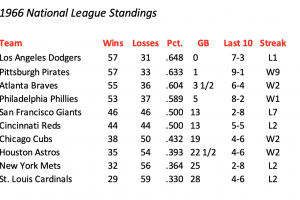
Went over to my buddy, Brando’s house last night to give the 1966 APBA set a tryout.  Call it spring training before I start my replay.  We spent a good half hour just going through the teams and looking over the players.  However, once he got to the LA Dodgers, Bum-lover Brando stopped there and started making a lineup.  “I’ll go with these guys”.  Of course, I knew that before I even came over.  Brando’s a die hard old-school Dodger fan.

I took the Cubs and we decided on a best of five series.  Game One saw Jenkins (BX) vs. Koufax (A&CXY).  The Cubs scored four off Sandy and he was history after seven but Jenkins pitched a complete game win giving up just one run.

Game 2 was Holtzman (CX) and Drysdale (CYZ).  Dodger lover he may be, but Brando let me know he thinks Drysdale is overrated.  Well, Drysdale got the win in the tough 4-3 LA win.  Lou Johnson helped with a two-run homer. 

In Game 3, I thought I’d give the old veteran Robin Roberts (DZ) a shot against Gomer Osteen (B).  It was the right call as Roberts pitched a shutout.  The Cubs offense came alive with seven runs.  Dolpho Phillips and Ernie Banks both hit dingers. 

Game 4 saw Dick Ellsworth (DZ) and Don Sutton (BXZ).  It was another tight game with the Cubs taking the game (and the series) 4-3.  Byron Browne and Randy Hundley both hit one out.  

Brando was a bit miffed that Koufax was missing a Z.  He allowed 77 walks in 323 innings in 1966.  I know APBA doesn’t calculate the Z on innings but rather on batters faced but it’s still hard to believe he doesn’t get control.  I tend to agree with him. 

Thanks to Brando for rolling the bones.  Thanks also for giving me a new hand-crafted dice cup.  In the past, Brando has made dice cups for himself out of wood and was nice enough to give me one.  This time however, he gave me a ceramic dice shaker.  Very nice! 

IMAG0009

Not only is it a good shaker but it’s heavy enough to conk someone on the head should I need a weapon. 

Below is the one he gave me a while ago made out of wood. 

dice shaker

Brando is indeed a man of many talents!

2 comments

5
February

Handy Tips for APBA Football Replays by Greg Barath

APBA Football fan Greg Barath was kind enough to pass on some valuable tips on conducting APBA Football replays.  Specifically, Greg hits on topics such as prepping for your replay, standardization, and your different methods of play depending on the down situation. 

Greg has wrapped this all up in a MS PowerPoint presentation entitled “Conducting Season Replays and Tips for Solitaire Play” which you can download and view here.  Also included in the presentation are some handy ways to score football games as well as keeping stats for teams over a season. 

This all looks very handy.  It ALMOST makes me want to try getting back into APBA Football and doing a late 70s replay again (I was a big Walter Payton fan). 

Thanks Greg!!

No comments yet

4
February

Joe Schuetz’ 1948 AL replay vindicates the Indians

Joe Schuetz wrote me to pass on details on his 1948 AL replay.  He included a great analysis of the replay.

I’ve included a few tables at the bottom of this post but for those who want to really delve into Joe’s replay, you can download his replay Excel spreadsheet.

Joe S says:

1.  Replay was based on the 1948 season issued by APBA in 1980; it was a basic board game replay  (no master game symbols) – cards and dice.  My Dad lived in Cleveland in ’48, regularly attended Indian games, and told me for years how great his ’48 Indians were, so I thought I would find out myself and replay the entire AL for that year.

2.  I wanted to maintain a semblance of accuracy, so prior to beginning, did some research on the season.   After finding a season schedule and basic league stats, I set up rotations for all teams projected over 4-week increments.  I monitored pitcher’s starts and appearances, as well hitter at bats, attempting to use everyone in proportion to their season usage.  I didn’t care about pitcher’s innings, figuring that the replay would take care of that.  For the handful of uncarded players, I created cards.  For players on more than one team, I brought them in at approximately the same time they showed up during the season.  Injuries during a game took the player out of that game alone, and I otherwise ignored the injury chart.

3.  While the Indians were clearly the best team in the league (proving Dad right once again!), the basic game APBA formula for that season  was put to the test.  Runs were being scored at a far greater rate than in real life, so by the All-Star break I decided to make adjustments to the game in the hopes of making individual games a bit more playable tactically.  I upgraded 28 pitchers based, more-or-less, on a bell-curve type determination.  I also added a few x, y and z ratings, but in a rather unscientific way.  While the first half league average was 11 points higher than actual, my second half adjustments proved to be overcorrection, as league batting in the second half was 9 points lower than actual.  APBA has continued to tweak to its formula over the years, and replays based on more recent models would probably yield stats a bit closer to actual.

4.  With regard to stat-keeping, mine were fairly detailed.  While I was curious about the “realism” of the cards, I also kept major stat categories for the fun of it.  Two stats that I regrettably did not keep were sacrifices and errors.  I have wondered for years how much of an impact APBA defensive grades impact runs scored, but unfortunately can’t come up with much of a conclusion.   I am a stat dork by nature, so it was not a chore; your call as to how far into the weeds you want to go.

5.  A couple of general observations:

a.  Tens (10′s) were significant in driving up hitters averages.  Those given 10′s generally had significant increases over actual averages.  I think APBA has addressed this to some degree over the years, as I have assumed that they saw the same thing from other replayers.

b.  A lot of 14′s and no Z’s really impacted scoring.  My replay produced 640 more runs than actual, aided and abetted by 292 more hits and 254 more walks.  The teams with little or no pitching (Browns, White Sox) were cannon fodder, making games rather unenjoyable.  And while most teams scored more than in real life, the Senators pathetic hitting made their games very boring.  That, however, will always be the case with the lower-end teams in a replay, so I recommend you adopt someone on the bad teams (Luke Appling, Al Zarilla, Eddie Yost in my replay) to maintain interest when that team is being played.

I greatly enjoyed this replay, and will attempt a few more as I head into retirement.  A dead-ball replay (1901, 1908) would be easy to do, but I would want to find some sacrifice stats and bunt at the same approximate frequency.  I still lean to the old 8-team leagues for replays, just to keep the number of games to a more manageable level.

I apologize for the length of this note.  Since APBA-dom has all types of members, those more devoted to “accuracy” may find the accompanying stats interesting/useful.  I look forward to reading about other replays.  If you need anything further, please let me know.”

Final hitting – replay
G AB R H 2B 3B HR BB SO RBI SB avg
Cleveland 154 5407 867 1594 241 59 143 631 524 783 40 .295
Boston 154 5416 940 1501 305 44 118 777 494 870 48 .277
New York 154 5492 845 1505 238 76 142 618 478 736 32 .274
Philadelphia 154 5319 859 1425 244 40 75 811 492 811 47 .268
Detroit 154 5327 838 1422 207 51 92 755 403 751 21 .267
St. Louis 154 5335 763 1396 270 72 71 583 551 687 79 .262
Chicago 154 5374 734 1420 154 54 62 692 543 661 57 .264
Washington 154 5234 632 1238 199 65 28 619 508 580 78 .237
42904 6478 11501 1858 461 731 5486 3993 5879 402 .268
Final hitting-actual
G AB R H 2B 3B HR BB SO RBI SB avg
Cleveland 156 5446 840 1534 242 54 155 646 575 802 54 .282
Boston 155 5363 907 1471 277 40 121 823 552 854 38 .274
New York 154 5324 857 1480 251 75 139 623 478 806 24 .278
Philadelphia 154 5181 729 1345 231 47 68 726 523 685 40 .260
Detroit 154 5235 700 1396 219 58 78 671 504 661 22 .267
St. Louis 155 5303 671 1438 251 62 63 578 572 623 63 .271
Chicago 154 5192 559 1303 172 39 55 595 528 532 46 .251
Washington 154 5111 578 1245 203 75 31 568 572 538 76 .244
42155 5841 11212 1846 450 710 5230 4304 5501 363 .266

***

Final pitching – replay                      
                       
  G CG IP H R ER BB SO W L ERA
Cleveland   57 1405 1138 591 508 641 518 107 47 3.25
Boston   69 1361.6 1397 709 674 607 441 87 67 4.46
New York   58 1382.3 1372 739 682 675 577 87 67 4.44
Philadelphia   58 1387.6 1401 739 664 719 493 83 71 4.31
Detroit   58 1362.3 1358 761 674 637 564 76 78 4.45
St. Louis   42 1378.3 1595 952 840 726 520 67 87 5.49
Chicago   40 1354.3 1628 986 851 710 397 57 97 5.66
Washington   31 1341 1612 1001 846 771 483 50 104 5.68
    413 10972 11501 6478 5739 5486 3993     4.71


Final pitching – actual*                      
                       
  G CG IP H R ER BB SO W L ERA
Cleveland 156 66 1409 1246 567 505 628 595 97 58 3.23
Boston 155 70 1379 1445 720 653 592 513 96 59 4.26
New York 154 62 1366 1289 633 569 641 654 94 60 3.75
Philadelphia 154 74 1369 1456 735 673 638 486 84 70 4.42
Detroit 154 60 1377 1367 725 635 589 678 78 76 4.15
St. Louis 155 35 1373 1513 849 764 737 531 59 94 5.01
Chicago 154 35 1346 1454 814 731 673 403 51 101 4.89
Washington 154 42 1357 1439 795 702 734 446 56 97 4.66
    444 10976 11209 5838 5232 5232 4306     4.29

I enjoy reading about replays like these. Not only does Joe compare his replay stats to the actual numbers but he tells what made it so fun (or not so fun in some cases). I enjoyed reading about the impetus (his father’s memories of the Indians’ 1948 season) for the replay too.
Nice read, Joe!

2 comments

4
February

Introducing APBA in the schools

While many of us are preparing to draft in leagues with other dingy old men, Brian Cavanaugh wrote me with another fantastic story.  He’s bringing APBA into the schools.

“Had our draft today for the inaugural C.W.Henry Elementary School APBA League and was lucky enough to land the first overall pick via lottery. Using the 2011 cards (the ones donated by John Herson) I took Halladay in the first and Price in the second. We finish up our rosters Thursday and start play next week….I’ll keep you updated.”

Later, he went on to say:

“I’m really excited and hopeful. The group of kids (6th-8th graders) are really excited and were totally into the draft, we ended up stayin a 1/2 hour later than planned. I will definitely keep you updated with the proceedings. I can’t remember who was #5 but I remember the top 3. I took Halladay at 1, Pujols went #2 and Josh Hamilton at #3. We are only using the playoff teams. It’s gonna be fun!!!!”


You might remember Brian as the one who formed the Bridesburg Boys and Girls Club Baseball League a couple years back.  Seems to me that he’s a one man force to change the demographic age of the APBA base.  I’m all for it!  Great job!

But Brian, I’m curious.  Do the girls enjoy APBA Sports as much as the boys?

1 comment

3
February

My IAL stats: Looking back at 2011

Our Illowa APBA League just finished its season in January and as usual, I got my stats done in the nick of time while in Pittsburgh.  Some stats of note:

Albert Pujols had a down year.  My friend Don S likes to tease me about Pujols and his “off” times but this time it’s worth noting.  For the 2011 season, Albert hit .296 with 34 homeruns.  Okay, not bad at all.  But this was the first year in his 10-year career with my team that he had less than 100 rbis.  He had 92.  It’s also just the third year he’s had less than 100 runs scored (95).  It didn’t help when Pujols went three nine-game series with only one homerun and just three rbis.

Time to trade him?  I know one Cardinal fan who would be more than happy to relieve me of him.  I don’t think so, though.  Good hitters are at a premium this coming year.

****image

Here’s an interesting stat:  After Albert Pujols, who had the most walks on my team?  Would you believe catcher Geovany Soto with 61?  Hard to fathom especially since he only played 103 games.  Soto sported six 14s on his 2011 APBA card and I just seemed to hit them.

****

Call it the “Tale of Two CY Starters”.   Exhibit #1 John Lackey had a terrific year for me in 2011.  He led my Thunderchickens in wins (15-10), strikeouts (154), and ERA (3.52).  I could usually count on “Big John” for a good outing.

Now, bring on Exhibit #2, Jeff Niemann also a CY.  Niemann had a hard year with a 5-17 record.  With a 6.02 ERA, it wasn’t a big surprise.  Thank goodness he won his last game or he would have lost more than four times than he won.

****

Finally, we get to the franchise pitcher, Stephen Strasburg.  Now, Strasburg (BKZ)didn’t get to pitch a lot in 2011 for us (and we won’t see him at all in 2012).  He got off to a rocky start.  In his second start, he got ejected arguing with the man in blue.  Rookie mistake… let’s not hold it against him, ok?  Two starts later, he gave up 12 runs in two innings.  During my visit to the mound that game, I told him, “You’re finishing this inning, Rook.”  That obviously took a while.

During the rest of year, Strasburg settled down and even ended up with a winning record (5-4).  His 5.72 ERA wasn’t anything to write home about but take away his two inning “lesson” and it would have been 4.24.  He ended up striking out 69 in 67 2/3 innings.

But I guess the most important stat for us is this:  68-94.  That was our won-loss record for the year putting us in last place.  The only silver lining is that it gives us the first pick in the 2012 draft.

For once though, I’ll be happy to take that 10th pick.

1 comment

2
February

APBA CEO John Herson interview: what’s new in 2012?

APBA HomeIn what is becoming a regular feature on The APBA Blog, we have the privilege of interviewing the CEO of the APBA Game Company, John Herson.

While some might see Mr. Herson’s tenure as controversial, no one can say he hasn’t been open to the fans of APBA.  This is the third interview he has done on The APBA Blog (you can read the others here and here).  In addition, he has also been open to questions on the APBA: Between the Lines forum via the “Ask John” threads.

I should say that none of these questions are mine.  While I’ve edited a few of them for brevity, all of these questions came from APBA fans who have either emailed them to me or left them in the comments section of the blog.  For that, thanks to all of you who helped participate in the interview in that fashion.

Finally, I thank Mr. Herson for his time and effort in answering these questions.


The APBA Blog:  Recently, the concept of a computer version of the APBA Basic Game has been developed independently by a fan who is programmer. A lot of fans have reacted positively to this idea. Can you tell us if this will be picked up by APBA or do you have something else in the works?

John Herson:  Last week we started Beta testing on BBW 5.75. This is the second round of testing on 5.75. Depending upon what is discovered during the Beta testing, will determine the release date of 5.75. We are planning a 2012 release of BBW 5.75. No release date will be set until after the Beta testing is completed.

Last summer, APBA created a two-year moving calendar for developing electronic products. We are reviewing the Basic game. As in all product development, there are many issues that have to be resolved, including how to support a product and offer as many seasons as possible. No decision regarding the basic game has been made at this time.

TAB:  The APBA Company has just released the 2011 disk and cards right on schedule. That said, there have been some complaints from customers about the physical format of the product. Specifically, I’m talking about the thickness of the card stock, size of fonts, and overall card design. Were these design changes done intentionally and how much of this feedback will you take into account for the future?

JH:  The stock issue was a miscommunication between the printer and APBA. A thicker stock will be used going forward.

We are experimenting with different fonts.

The unhappy voices about the cards have been loud, but they are not the majority. APBA has received more positive comments than negative comments about the cards. The 2011 season was the eighth set we have issued using this printer, card stock and card design. We are willing to listen to customer feedback. However, comments like “they suck” provide us no meaningful information.

The overall card design is not changing.

TAB:  What are the new products coming out in 2012? New season releases? A possible upgrade to the soccer game?

JH:  The next baseball season will be 1910. There will be several changes with the 1910 set. Instead of a lineup sheet, there will be a lineup card for each team. The lineup card will be the same size as the player card. Fans will be able to download an electronic copy of the lineup sheet from APBA’s website. The other change is we will be offering two different card sets. A basic card set (without master symbols on the card) and a master card set with master symbols printed on the card. We will not offer a separate master symbols sheet for the 1910 season. After the 1910 season is released, we will issue another baseball season that we have never issued before.

The 2011 golf cards will be printed on cards instead of sheets. We are reworking the files for the printer. The new golf cards will be available in February. For hockey, we will be offering the 1988-89 season in February. This set will be on cards instead of sheets. We are proofing the cards as I write this. More information will follow on this set and other sport sets.

The 2011 football set will be on cards instead of sheets. We will offer four different sets. One is the 2011 playoff teams. One is the American Conference. Another one is the National Conference. The last one is the entire league. We are offering these sets to help with the pricing of the sets.

The soccer game has just about sold through for the second time. The third version will be redone. The box will be a two piece box roughly 11 by 17. The game box artwork will change slightly. The soccer pitch will be the size of a Monopoly board with similar game board backing. The game chart booklet will be 11 by 17. The booklet will have white background with black printing. The teams in the game will be updated to 2010-11 teams. Eventually all the APBA games will have the same size and type of packaging. After soccer, we will redo the golf game box so that the golf chart and golf course are shipped in the same box. This will allow certain retail chains to carry the golf game.

Please check the website for pricing information on these products.

Now that the crush has cleared from the 2011 season rush, we will begin to release reprint sets. We have the files for 1927, 1929, 1958, 1961 and 1963 at the printer. The goal remains the same. To have all season sets in stock by July of 2012.

We are updating the order entry system including the Yahoo Store experience. The pricing is too complicated. The product listings are not descriptive enough. The store order is not automatically entered into APBA’s system. We are not able to send delivery confirmations. All of these issues will be addressed. We will be looking at the shipping and handling charges. The current system does not work. As part of this a new website will be launched. We will pick a weekend in February, shut down the website for 48 hours to re-launch the website.

TAB:  What is the possibility of digitizing the roster sheets for existing card sets and putting them up on the website?

JH:  As we distribute the last of the printed lineup sheets we will convert to the line-up cards. As part of that process, we will be able to make the roster sheets available. It is not something we will do as a special project. We are focused on getting product to our fans.

TAB:  Finally a philosophical question from Paul Dylan at oneforfive.com. Looking back six months, what was the emotional impact of moving headquarters from Lancaster to Alpharetta? What was the emotional impact on your customers and what was the emotional impact on you?

JH:  I bought APBA six years ago May 2005. Sometimes I feel like the dog that caught the car. For the first three years I owned the company, I still worked in the large corporate world. After I retired from the large corporate world, I focused on APBA. I spent the first five years learning the APBA business. I did not make an announcement about the purchase because the company had three public faces, Marc, Skeet and Veryl. There was no reason to change the public face of APBA until the move was made to Georgia.

There were several changes I wanted to make to the APBA business model. Primarily reduce the investment in inventory. For whatever reasons, we could not find printers to make the new model work in the PA, NJ and Delaware area. I found printers in the Atlanta area that could deliver just in time inventory. It made no sense to ship the product back to PA to distribute. So I decided to move the operations to Georgia. There was no emotion involved in the decision. It was a business decision. I was concerned about the guys in PA. Skeet still works for APBA. Some of the other guys were offered jobs and did not want to move. I can look in the mirror and know I was as fair as possible to the Lancaster team.

Some have asked why didn’t I move to Lancaster. I used to live in Wisconsin. I live in Alpharetta. I have no desire to move back North.

Was I surprised about the emotion of the fans? Yes, to some extent. However, there is an element, especially on the forum, that likes to the bash the company. For what reasons I don’t know. Some people you are never going to please no matter what you do or don’t do.

These decisions were made in the best long term interest of APBA.

We are committed to offering the best products and services to the APBA community. Did we have issues with the 2011 products? Yes, it went OK but mistakes were made. We will continue to improve products and shipping materials. At this time, no new games will be introduced in 2012. We continue to look at new product offerings. Realistically it takes two years to develop and bring a game to market.

Tom, I appreciate the opportunity to be on your blog and address the APBA community.

Regards, John


Again, thanks to John Herson for doing this.

A quick note about comments:  I know this kind of thing is a hot button topic but let’s keep it constructive.  If you have a criticism, that’s fine but I don’t want to see name-calling or senseless belligerence.  Thanks

9 comments

31
January

Monster Card Tuesday (??): 1930 Hal McKain

image

Yes, today’s Monster Card Monday is one day late.  With my trip to Pittsburgh last weekend and other foreseen consequences, I had to delay MCM one day.  Never fear, it’s here. 

Harold Leroy “Hal” McKain of 1930 is this week’s Monster Card.  He fits the bill.  Though he’s only a DY, his hitting card makes Lou Gehrig blush.  He’s got power numbers of 2-2-2-6 plus four 7s.  Not only that APBA gave him four 14s. 

McKain deserved those 2s, by the way.  In 1930, he hit four triples in 31 at-bats for the White Sox. 

Split G GS PA AB R H 2B 3B HR RBI SB CS BB SO BA OBP SLG
1930 Totals 33 5 37 31 9 13 1 4 0 6 0 0 4 6 .419 .486 .710
Provided by Baseball-Reference.com: View Original Table
Generated 1/31/2012.

McKain didn’t amount to much of a pitcher at the big league level.  He won six games each in 1929-1931.  He did manage a 3.65 ERA in 1929. 

But those 2s! 

No comments yet

27
January

Can’t avoid baseball in Pittsburgh

Last night I took the overnight bus to from Champaign, IL to Pittsburgh.  I’m here for the weekend to see an old friend but that doesn’t mean I can stay away from baseball.

PNC Park greeted me as I woke up this morning.  It was on the other side of the Allegheny River as our bus rode into town.  In my opinion, it’s one of the best new baseball parks I’ve been to.  I saw a Pirate-Reds game there some eight years ago.  It’s like they did everything just right.  Now, I haven’t been to Miller Park yet and I’ve heard the same about that stadium so maybe the jury’s out yet.

But that’s just their fancy new fangled stadium.  Turns out my friend works at the Carnegie Library of Pittsburgh which is practically across the street from where old Forbes Field stood.  While he worked, I went exploring…

008

There is a nice sign where Forbes Field’s outfield used to be, commemorating the old stadium and what it stood for.


011

People can still see the original centerfield and right field walls.

013

The 436 ft. mark of right field.


017

A University of Pittsburgh student building now stands where Forbes Field’s home plate is but thankfully, they have left preserved the home plate used in its last season in its exact location.

There’s Mazeroski, of course.  Every Pirate fan and anyone who knows baseball is familiar with that story.  But there’s also the story of Babe Ruth’s last three homeruns, 712, 713, and 714 which were hit at Forbes Field.  There’s a bit of controversy surrounding this.  Early reports of Ruth’s final homerun’s landing spot has it in foul territory.

From a 2006 article in the Pittsburgh Post-Gazette:

Original accounts from the Pittsburgh Press indicate that the ball scorched to earth, hitting a rooftop at 318 Bouquet St., in the city’s Oakland section, some 600 feet from home plate. Except that there’s a knot in that yarn: Bouquet Street was in foul territory. No one contests that the home run was legitimate, nor is their any argument that it was a titanic blast. But further research has indicated that No. 714 — the last of three Ruth hit that afternoon in an 11-7 Boston Braves loss to the Pirates — most likely touched down behind the right field fence on Joncaire Street and either ended up in a backyard on that street or bounced down the steep hill toward Panther Hollow and was chased down by a small group of boys.

An interesting story nonetheless.

[edit] I’ve added a few more photos from the Forbes Field area.

008


014


011


010

7 comments

« Previous Entries